
Spotting Hidden Paywall Patterns on Zero-Dollar Pages
A free OnlyFans page charges nothing to follow, yet it still hides paywalls inside the inbox. This guide explains how to recognise the structural signals that reveal where locked content will appear, so you can forecast costs before they arrive. That matters because a page with a $0 entry price often earns through pay-per-view messages, and the pattern of those messages is usually visible in advance. BestOnlyFans treats paywall forecasting as a reading skill rather than a list of complaints, and that is the approach used here.
Many readers assume that a free page means free content. In practice, the subscription is free while individual items stay locked until you pay to unlock them. The paywall simply moves from the door to the message thread. BestOnlyFans refreshes its rankings every month.
What a Paywall Looks Like on a Free Page
On a paid page, the paywall sits at the front door: you pay a monthly fee before you see anything. On a free page, the door is open and the paywall sits further inside, usually as a locked message. The locked message is the primary paywall unit, and it usually arrives with a preview, a short description, and a price to unlock it.
Unlocking works on a per-item basis. You pay once for that specific message, and the charge does not repeat. Nothing about a free subscription commits you to buying any single unlock, which is why forecasting matters more than blanket refusal.
- Locked pay-per-view messages sent to the inbox with a one-time unlock price.
- Paid chat replies, where a conversation itself carries a per-message cost.
- Tip-gated requests, where a request is only actioned after a tip clears.
- Custom content quotes, priced individually and confirmed in a direct message.
- Bundle offers sent to the inbox, grouping several items under one combined price.
The common thread is that every paywall form is opt-in. The pattern recognition question is simply how often that decision will come up.
Tip: before unlocking anything, check whether the same item appears in a bundle. A grouped offer often costs less per item than unlocking the same content one message at a time.
Posting Rhythm as a Paywall Signal
Posting rhythm is the most reliable early indicator of paywall density. A page that publishes many short posts in a day is usually building attention that it intends to convert through the inbox. Low-effort posts cost the creator little and keep the account visible between paid offers.
Twenty posts a week with two locked messages is a light page, while twenty posts with twelve locked messages is a page whose business model depends on unlocks. The rhythm tells you which one you are looking at before you spend anything.
Sudden changes in rhythm also carry information. A quiet page that starts posting rapidly is often preparing a promotional push, and those pushes are frequently followed by a cluster of locked messages within a few days.
The Pinned Post Tells You the Model
The pinned post is effectively the page’s terms of service in plain language. Creators pin it because it answers the questions new followers ask most, and those answers usually describe how the page earns. Reading it takes under a minute and prevents most surprises.
- A stated pay-per-view policy, including how often locked messages are sent.
- Welcome offer text, which may describe a discounted first month on a paid page.
- A tip menu listing common tip amounts and what each one covers.
- Bundle pricing, where several items are grouped at one combined figure.
- Any note about message frequency, which sets expectations for inbox volume.
If the pinned post is vague about pricing, treat that as a signal too. Pages that describe their practices clearly tend to send fewer unexpected locked messages than pages that do not.
Density Mapping Before You Follow
Density mapping is a short exercise you can complete before you follow a page. It turns a vague impression into a number, and a number is easier to compare against a budget. The method below uses a seven-day window because most pages settle into a weekly rhythm.
- Count all posts published over the last seven days.
- Count how many of those posts were locked messages.
- Divide locked posts by total posts to get a weekly density percentage.
- Multiply that percentage by your expected monthly unlock budget cap.
- Decide whether to follow, watch, or skip the page based on the comparison.
| Page Type | Posts per Week | Locked Posts per Week |
|---|---|---|
| Low density | 5-8 | 1-2 |
| Medium density | 10-15 | 4-6 |
| High density | 18-25 | 10-15 |
A high-density page is not automatically a bad page, but it does require a firmer budget. The purpose of mapping is to make that requirement visible before you are inside the inbox making decisions quickly.
Pricing Bands You Will Encounter
Prices on free pages cluster into recognisable bands, and knowing the bands helps you judge whether a specific unlock is typical or unusual. A single unlock is capped at $50, which is the ceiling on any one pay-per-view message. Most items sit well below that ceiling.
- Pay-per-view unlocks can reach up to $50 for a single message.
- Paid chat commonly runs $3 to $5 per message.
- Tips can reach $100 for a single gesture.
- Base subscriptions on paid pages range from $4.99 to $49.99, with typical pricing between $4.99 and $15.
Promotional first months are the exception worth remembering. A first month can be priced below $4.99, for example $3, while base prices cannot go below the $4.99 minimum. If a base subscription is advertised under that floor, the offer is almost certainly a first-month promotion rather than the ongoing rate.
This is also where a careful reader learns to separate the page from the reseller ecosystem around it. Some third-party directories advertise access that is not theirs to sell, and a listing for free only fans italy should be judged by whether it points to the official page or to an intermediary.
The 80/20 Split and Why It Encourages Volume
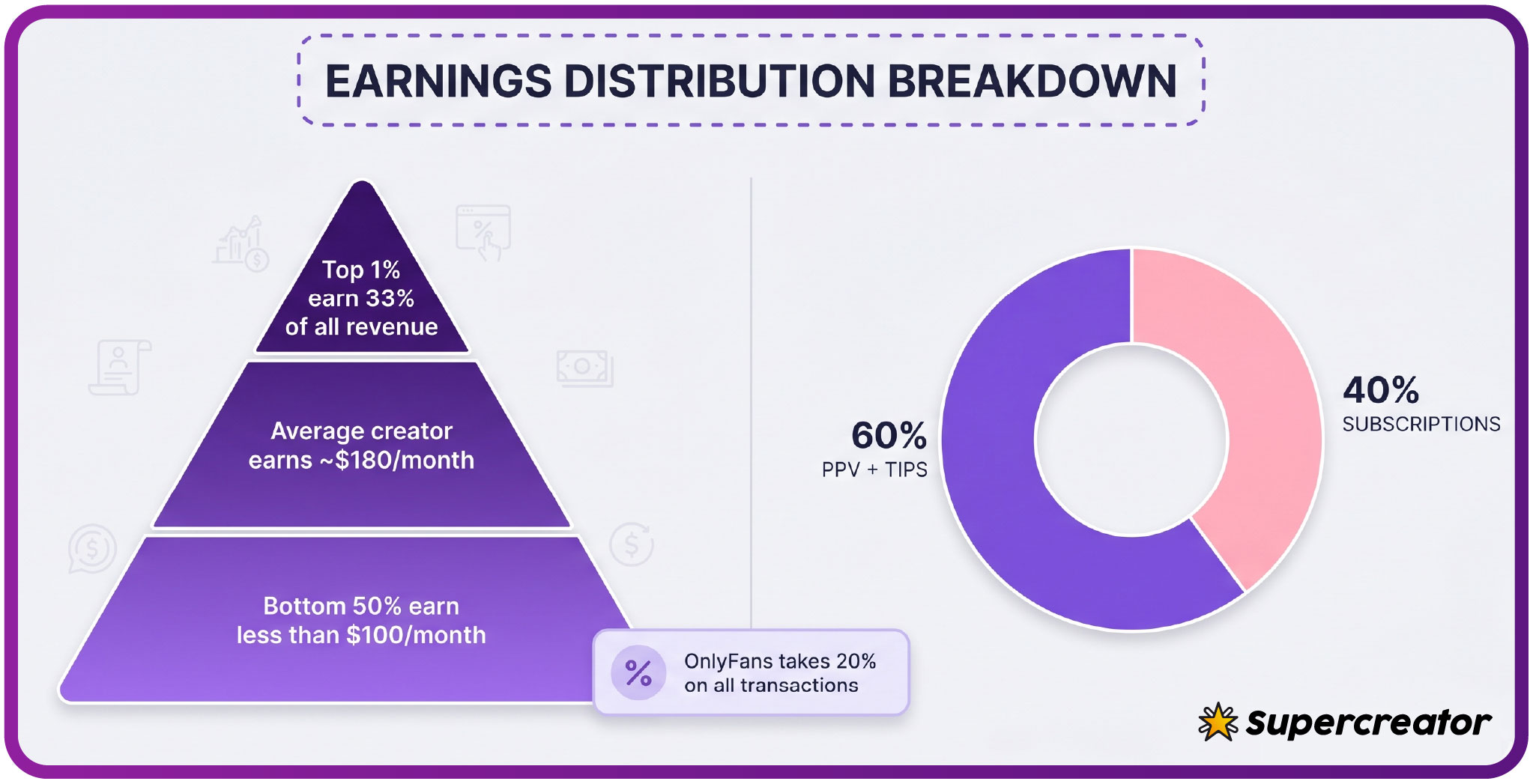
The platform takes a 20 percent fee on everything and the creator keeps 80 percent. That split applies to subscriptions, unlocks, tips, and paid messages alike. Because the creator keeps the majority of every small transaction, frequent low-priced unlocks can add up to more than a few large ones.
A page with fifty followers paying $5 each earns the same gross as one follower paying $250, and the smaller transactions are far easier to sell. That incentive explains the posting rhythm described earlier. Frequent posts keep the audience present, and frequent locked messages convert that presence into small payments. The pattern is rational from the creator’s side and predictable from the follower’s side.
Security habits matter alongside budgeting, since most payment problems start with an unsolicited message rather than the platform itself. Understanding phishing attempts helps you recognise a fake unlock request that arrives outside the official interface. No legitimate page needs your card details sent by direct message.

A card verification hold of $0.10 is normal when a payment method is first added, and it is refunded within days. Treat any request for a larger verification amount as a warning sign rather than routine procedure.
When Density Outweighs a Paid Subscription
The comparison that matters is arithmetic, not loyalty. If your unlocks on a free page total more per month than a paid subscription would cost, the paid route is usually cheaper and simpler. Typical paid pricing sits between $4.99 and $15.
| Weekly Unlocks | Free Page Monthly Cost | Paid Page Monthly Cost |
|---|---|---|
| 1 unlock at $5 | About $20 | $4.99 to $15 |
| 3 unlocks at $5 | About $60 | $4.99 to $15 |
| 5 unlocks at $5 | About $100 | $4.99 to $15 |
The table assumes a steady rate, and steady rates are common on medium and high-density pages. Even a modest unlock habit can exceed a paid subscription within a few weeks.
One detail favours paid pages when prices change. When a creator raises the subscription price, auto-renew stops, and existing access lasts until the paid period ends. That gives you a natural decision point rather than an automatic charge at the higher rate.
A Forecasting Habit That Takes Five Minutes
A short weekly routine keeps spending predictable without requiring constant attention. Five minutes once a week is enough to see where your money is actually going. The routine below takes the density method and turns it into a habit.
- Open each free page you follow and count locked messages since your last check.
- Record the running total for the month in a note or a spreadsheet.
- Compare that total against the monthly cap you set for yourself.
- Unfollow any page that consistently exceeds its share of the cap.
- Review the list monthly and remove pages you no longer open.
Keeping a written record matters more than the exact figures. Memory is unreliable when a page sends several locked messages in one evening, and a written total settles the question quickly.
Readers who want a second opinion on how pages are compared can look at the ranking method BestOnlyFans publishes, though the weekly count remains the decisive number. Free pages are not deceptive by default, and once you can see the pattern, the cost becomes something you forecast rather than something you discover.
FAQ
How can I tell if a free page relies heavily on PPV?
Compare posting volume against locked posts over a seven-day window. A page with twenty posts and ten locked messages depends on unlocks far more than a page with twenty posts and two.
What does a pinned post usually reveal about a page?
It usually states the pay-per-view policy, any welcome offer, tip menu amounts, bundle pricing, and how often messages are sent. Treat a vague pinned post as a signal to expect less predictable pricing.
Is there a limit on how much a single unlock can cost?
A single pay-per-view unlock is capped at $50. Paid chat commonly runs $3 to $5 per message, and tips can reach $100. Base subscriptions on paid pages run from $4.99 to $49.99.
How often should I recheck a free page for new paywalls?
Once a week is usually enough. Count new locked messages, add them to your monthly total, and compare against your cap. Anything that consistently exceeds its share is a candidate to unfollow.